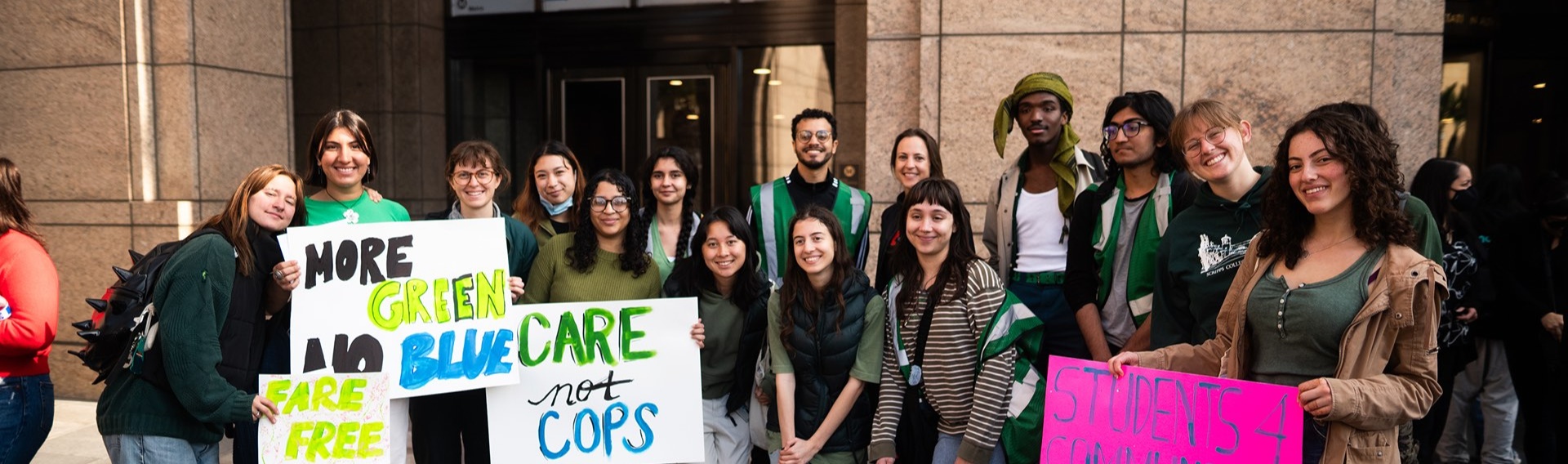
In just over five years, Metro’s multi-year policing contracts with Los Angeles Police Department (LAPD), Los Angeles Sheriff’s Department (LASD), and Long Beach Police Department (LBPD) had ballooned to more than $1.1 billion dollars. Policing transit riders had not resulted in increased safety on the system and instead caused a disproportionate number of citations and arrests of Black riders. Despite making up 18% of transit riders, Black riders have been issued 50% of citations and arrests by Metro’s contracted sheriffs and police officers.
Responding to decades of community advocacy for a care-based approach to safety, Metro started their own Department of Public Safety in 2024. While Metro’s new safety department aims to match the right resources, including transit ambassadors, to the varied safety needs of LA’s transit riders, Metro’s new department still plans to also employ and contract with armed enforcement officers.
What if our Metro stops and stations were deeply invested in—and were built to provide care and safety to transit riders? ACT-LA believes thoughtful design and the intentional investment in care-oriented programs can build an infrastructure of safety that all Metro riders can feel.
Safety can come from infrastructure like:
Ample lighting at stations and stops
A constant, friendly, knowledgeable presence at stops in the form of transit ambassadors
Homeless outreach workers
Information kiosks
Bathrooms with attendants
Maintenance workers who proactively maintain the quality of our transportation and spaces
Frequent and fast transit service
Together they make up an ecosystem that transforms our transit system into a sanctuary for all riders.
ACT-LA worked with community partners and transit riders to visualize how our transit stops would transform if we invested in these infrastructure and program interventions, activating the Compton, CA Metro station. In our report “Metro as a Sanctuary: Reimagining Safety on Public Transit”, we surface real solutions like wayfinding transit ambassadors, outreach for unhoused riders, elevator attendants and other new programs. The report puts forth a vision towards care-based safety strategies on transit instead of the status quo of the current ineffective police-first approach.
Our transit system can and should be a sanctuary that connects Angelenos to opportunity and services and provides a welcoming public environment that attracts riders to the system.
“We deserve a public transit system where ALL riders feel safe. @metrolosangeles: put an end to the bloated, ineffective policing contract that targets and criminalizes Black riders and invest in non-policing community safety alternatives. #PeoplesTransit.”
Advancement Project California (@AP_California)
What if our metro stops were sanctuaries?
